Neutron Reflectivity
Neutron reflectometry is a laboratory technique for measuring the structure of thin films, similar to the often complementary techniques of X-ray reflectivity and ellipsometry. The technique provides valuable information over a wide variety of scientific and technological applications including chemical aggregation, polymer and surfactant adsorption, structure of thin film magnetic systems, biological membranes, etc.
The technique involves shining a highly collimated beam of neutrons onto an extremely flat surface and measuring the intensity of reflected radiation as a function of angle or neutron wavelength. The exact shape of the reflectivity profile provides detailed information about the structure of the surface, including the thickness, density, and roughness of any thin films layered on the substrate. Neutron reflectometry is a specular reflection technique, where the angle of the incident beam is equal to the angle of the reflected beam. The reflection is usually described in terms of a momentum transfer vector, denoted qz, which describes the change in momentum of a neutron after reflecting from the material. Conventionally the z direction is defined to be the film normal direction, and for specular reflection, the scattering vector has only a z-component. A typical neutron reflectometry plot displays the reflected intensity (relative to the incident beam) as a function of the scattering vector:

where λ is the neutron wavelength, and θ is the angle of incidence.
Neutron reflectivity measurements are carried out at the Laboratoire Leon Brillouin in Saclay using the EROS time-of-flight spectrometer. The technique requires a neutron source, which is a research reactor. The reflected intensity at grazing angle of a non polarized white neutron beam is measured as a function of wavelength. The wavelength is in the range of 2-30 A. The angle of incidence, θ which remains constant during the measuring time, is between 0.75° and 0.95° depending on the two seminfinite media. All type of interfaces might be studied, including air/liquid interfaces. Like all neutron scattering techniques, neutron reflectometry is sensitive to contrast arising from different nuclei (as compared to electron density, which is measured in x-ray scattering). This allows the technique to differentiate between various isotopes of elements. Neutron reflectometry measures the neutron scattering length density (SLD) and can be used to accurately calculate material density if the atomic composition is known.
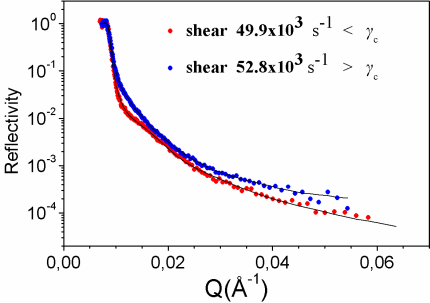
Reflectivity profile of PS-PEO 80 kg/mol brush measured at 49.9x10^3 s^-1 (red) and 52.8x10^3 s^-1 (blue), after 1 h exposure to shear flow. Since the solvent (toluene) is deuterated while the polymer is hydrogenous the increase in reflectivity observed at 52.8x10^3 s^-1 indicates desorption. The continuous lines are least-squares fits based on parabolic volume fraction profiles

Parabolic volume fraction profiles for the two shear rates of 49.9x10^3 s^-1 (red) and 52.8x10^3 s^-1 (blue). The respective adsorptions are 2.32 mg/m^2 and 0.24 mg/m^2 (practically total desorption).